Welcome to My Blog

Hello world! Nice to meet you :)

What is ICT

ICT is an acronym that stands for Information Communications Technology. ICT covers any product that will store, retrieve, manipulate, transmit or receive information electronically in a digital form. For example, personal computers, digital television, email, robots

Character Education

Character education is the teaching of core values. For example, the Character Counts program defines six teachable "pillars of character": trustworthiness, respect, responsibility, fairness, caring and citizenship.

Travelista

It is about my hometown journey, travel and culinary.

Olivia's Note

My notes, my story, my opinion..

Showing posts with label education. Show all posts

Wednesday, 23 July 2014

Teaching in Indonesia

WARNING! This video is just a joke... No offense ya.
Here they are anyway though of the types of teaching jobs in Indonesia!


Saturday, 12 July 2014

Structural Assignment : Teaching Learning with ICT

1.     Why do you think we need ICT in teaching learning process?
Because learning takes place everywhere, not just in the classroom. Today, we are in 21st Century, ICT can empower teachers and students, promote change of the teaching learning process to be better and foster the development of 21st Century skill. By ICT, we can connected to the world (locally and globally). We can learn from teachers around world. We can share our ideas and ask our question without gap. The information and knowledge are unlimited if we applied ICT in teaching learning process.

2.    In what ways ICT can really help both teacher and students?
ICT can helps teacher enjoy the teaching-learning in class and the students enjoy their learning and doing their homework. In ICT, there are some options to learn, such as blogging, broadcasting, Google document presentation and social networking.
By blogging, students can have learning experiences. The students can share ideas, videos and their own website. They learn to be creative and productive by design their blog and share their words with the world. Then the students can get comments and feedback about their materials. The teacher can give his or her suggestion and advice for their blogs. It really helps the students to get the confidence from the feedback of their friends, teachers or people around the world.
By broadcasting, students can record their own video about any subject and the teacher can listens the broadcast from the students and then give them a feedback. The students can also listen to the other broadcast and learn from it.
By Google document presentation, the teacher can presents a slide show that have been talked in the class. The students can develop the presentation to be more interesting by text, graphic and pictures to present the project. Google documentary also offers the capability of sharing their works with anyone, anywhere in the world.
By social networking (for example Twitter), the students can connect to their teacher and the others by following the tweets. The teacher can gives a discussion topic in a tweet and the students can share their opinions by reply their teacher’s tweet. It helps them to share their ideas and get the point from the “chat”.
Both teacher and students can learn about critical thinking, generalist (broad) competencies, ICT competencies enabling expert work, decision-making, working as a member of a team, when students have a group project and do it with their friends as a group, and the teacher can be a part of that team, and also learn about communicating effectively.

3.  Which do you prefer to ask, what computer can do for us, or what we can do with computer? Mention the reason.
What we can do with computer. Because computer is a general-purpose tool with many uses, so the primary limits on what it does are set by the choices of its user, us. We, humans, can explore the computer’s function and innovate the program on computer, improve our creativity on computer.


Sunday, 6 July 2014

Giving and Responding to Bad News

When you have bad news, there are ways to do it correctly, and ways to make a mess of it.  It is always not easy to deliver bad news. But at least you know the appropriate words when you have to do it.

First, before you deliver the bad news, you can say: “Hey, I’m afraid…”  Example: “Hey, I’m afraid your cat’s died.”
Or you can also say in a longer sentence: “Hey, I’m afraid I’ve got some bad news for you.” Example: “Hey, I’m afraid I’ve got some bad news for you. Your cat’s died.”
Or you can exchange the words: “Hey, I’ve got some bad news for you, I’m afraid your cat's died.”
Alternatively, you can say: “Unfortunately, I’m afraid…” So, the sentence is: “Unfortunately, I’m afraid your cat’s died.”
Don’t forget, at the end you have to say something positive. Example: “it’s better for your cat. He was terribly sick, right?”

Now, what if someone gives you some bad news? How do you respond?
For example: “Hey, I’m so sad. My cat's died."
For expressing shock, you can say: “Oh my God! That’s awful/terrible!”
Or, you can imagine how your friend feels: “You must be feeling absolutely terrible/awful.”
If you have heard the news from someone, you can say: “I’ve heard about it. I’m so sorry to hear that.”
Last, show your support by saying: “Anytime you want to talk, just call me.”
Otherwise, you can also say: “If you ever need to talk to someone, you know where I am.”
You can also offer help: “If there’s anything I can do, just let me know.”

That is all about giving and responding to bad news, hope you can remember the ways to give and respond the bad news.

References :
http://englishtips4u.com/2013/07/09/engtalk-giving-responding-to-bad-news/


Friday, 27 June 2014

Comma Rules in Writing

*click this image to enlarge*

Hope you will be good in using commas, especially in writing English. :)

source : www.myenglishteacher.eu


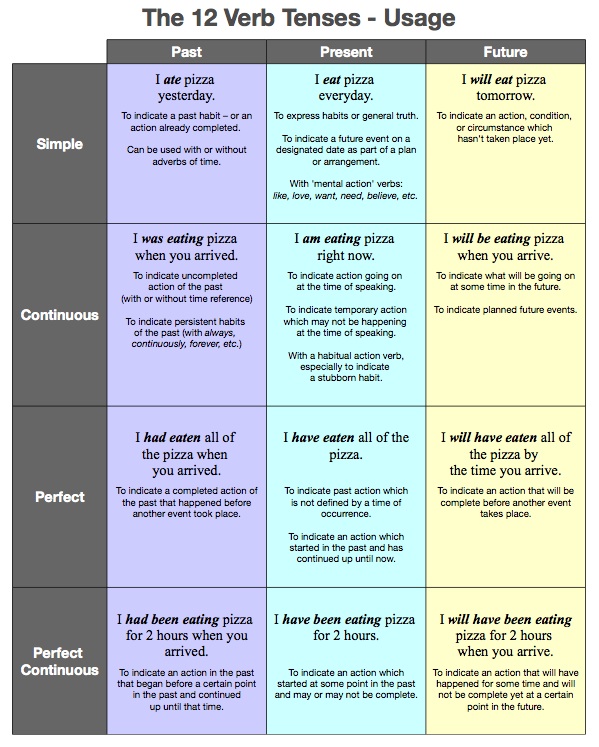
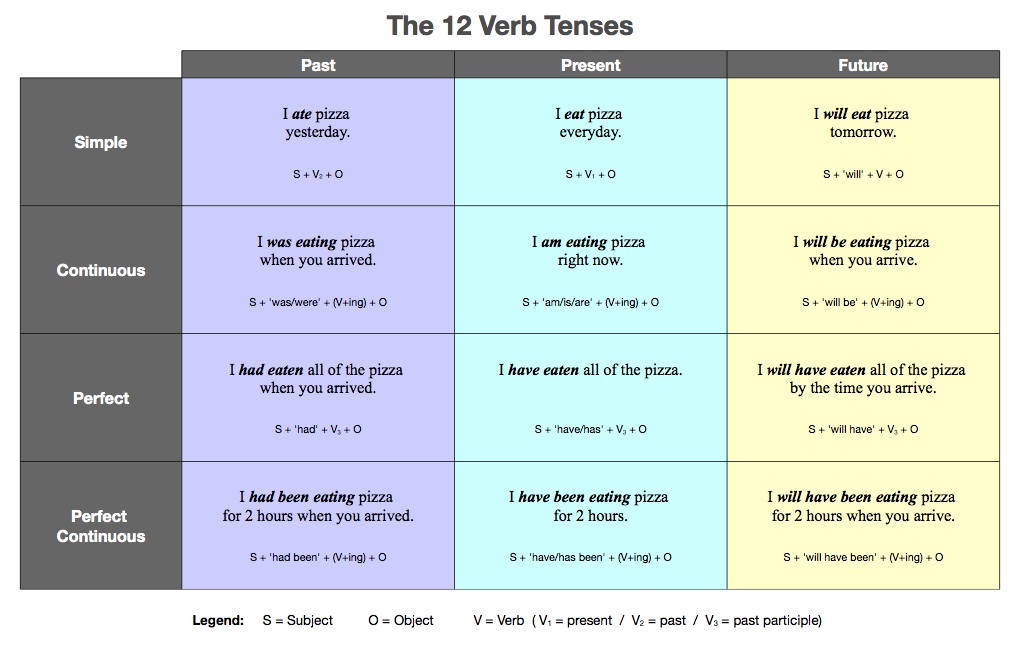
12 Verb Tenses - English Grammar Tenses

12 verb tenses in a table. Learning what they can be used for. English grammar lesson.

Tenses are all used to indicate action that has taken place in the past, present, and future. The following two photos will show how and when you can use each of the tenses.


*click to enlarge the image*

*click to enlarge the image*

Source : www.easypacelearning.com

Making Grammar Lessons More Interesting

Unless linguistics and language is a passion, most people neglect grammar and hate learning it.As a matter of a fact, there are many different teaching methods which nowadays people do not focus on entirely teaching grammar. It is important to realize that students have different learning needs. Some will take a more logical approach, whereas others will be more inclined to simply use the language as they receive it. An effective teaching method is learning how to blend these two together. Some schools will focus entirely on language acquisition. They will forgot the use of teaching grammar techniques. However, when it comes to teaching in schools and other institutions this might be required. Sometimes the examinations which students are preparing will focus entirely on grammar and therefore it is essential to know how to get these points across to the students.

There are many different ways of making grammar a little more interesting. A variety of different games can be designed in order to help with this. The Internet is a brilliant resource when it comes to this, and is indeed a blessing to many teachers. Another important thing to remember is repetition. Repetition will often allow the words to sink into the students’ minds easier.

Here are four great ways to make grammar lessons more fun :First, using songs. If you are an audio learner, then music is a great way for you to learn English grammar. By singing phrases, it will become implant into the mind a lot faster. In order to do this, find a song that uses several tenses or different grammar points. Sing along and then, write up the song's lyrics on the board or paper. Sing the song until you get the tune into your head. Then make a game, say or sing a verse or phrase from the song, but change the tense. By this way, you will be able to practice with using the different tenses and verb forms, but in a much more light-hearted way. See our other articles “Classroom Songs: 16 Creative Ways” and “How to Teach Using Songs” for more ideas on using songs.

Second, make the grammar lessons into a game. There is no doubt that playing games will make learning a lot easier. Both adults and children love these. Perhaps even make it into a competition. This will often get the people motivated to get the answers right and therefore allow them to learn much faster. Among teenagers, this can be particularly effective, whether the class is divided into two or more groups. By turning it into a competition, everyone will become a lot more active and a lot of fun can be had by everyone.
Third, tell a story. Getting form a “story stick” whereby everyone contributes a line to the overall story. If there are any grammar mistakes in this, then leave it until the end. When the entire story is finished and written out on the board, come up to it and make the appropriate corrections. With participation from the class, have the entire text corrected. Ask the students questions as to why certain tenses are the way they are. Having something to focus on like this will keep the students’ attention and therefore allow for the understanding of grammatical structures to sink in a lot easier.
Last, if you are preparing for a college entrance examination or any other kind of test, then simply knowing grammar structures may be the key to passing it. If the learners have been doing grammar all along but still don’t understand the mechanics, then it is important to make sure that they receive a crash course in it. English grammar can be relatively simple when it is all laid out. Start from the beginning, take a few practice exercises and let it work your way up. It is also a good idea to create a “grammar book” whereby you can write down the various sentence structures and tenses, class by class, so that you will always have a reference. In fact, having a comprehensive reference for grammar is probably one of the best things to do. At the beginning of the course, it is a good idea to start simple and help you to work your way up to the more complex forms. A reference will allow them to be more solidly grounded and can be good for doing exam revision with.

For addition, lets take a look to this video guys ~

That’s it guys, I hope this post will be useful for you :) Share your ideas about making grammar lessons more fun. See ya !

Reference :


Wednesday, 25 June 2014

Which Came First - The Chicken or The Egg?

My lecturers have been asked me and my friends about this question. Actually, I didn't know the 'right' answer. I just knew that if I asked "the egg or the chicken", then the answer is the egg. But if I asked "the chicken or the egg", then the answer is the chicken.

Then, here the scientific answer. Please watch it ~


Fun Educational Tool


This video suggests us to change the learning process. It gives us new ideas for the development of education. It introduces us a good game that could be used as a learning tool. So, click play to the video and get more information. Enjoy!

*note : MindSticks is an addictive puzzle game that will help you have fun and spend time with benefit. Challenge yourself through more than 30,000 puzzles.


Thursday, 19 June 2014

English is "Crazy"

This video remains me with Linguistic lesson :D
Let's watch it!


History of English


History of English Language (1943)


Wednesday, 18 June 2014

5 Sky Idioms in English


source : as tagged
It's spring time, so check out a few English idioms related to the sky! Here are 5 sky idioms in English. :
  • HIGH AS A KITE - very drunk or drugged. For example: Oh man, I’m high as a kite!
  • GO SKY-HIGH - to go very high. For example: It’s so hot - the temperature went sky-high!
  • SKY’S THE LIMIT - there is no limit to what something or someone can achieve. For example: You can do anything - the sky’s the limit.
  • OUT OF THE BLUE - suddenly, unexpectedly. For example: One day, out of the blue, she announced that she was leaving.
  • REACH FOR THE SKY - to set your goals high. For example: Go for it! You should always reach for the sky, Mark.


Sunday, 1 June 2014

Bloom's Taxonomy

According to Wikipedia, Bloom's taxonomy is a way of distinguishing questions within education. It is named for Benjamin Bloom, who chaired the committee of educators that devised the taxonomy, and who also edited the first volume of the standard text,Taxonomy of Educational Objectives: The Classification of Educational Goals. Read more at : Bloom's taxonomy

Bloom's wheel, according to the Bloom's verbs and matching assessment types. The verbs are intended to be feasible and measurable.

Bloom's Taxonomy was created in 1956 under the leadership of educational psychologist Dr Benjamin Bloom in order to promote higher forms of thinking in education, such as analyzing and evaluating, rather than just remembering facts (rote learning). - Read more at: Bloom's Taxonomy of Learning Domains

"Taxonomy” simply means “classification”, so the well-known taxonomy of learning objectives is an attempt (within the behavioural paradigm) to classify forms and levels of learning. It identifies three “domains” of learning (see below), each of which is organised as a series of levels or pre-requisites. It is suggested that one cannot effectively — or ought not try to — address higher levels until those below them have been covered (it is thus effectively serial in structure). As well as providing a basic sequential model for dealing with topics in the curriculum, it also suggests a way of categorising levels of learning, in terms of the expected ceiling for a given programme. Thus in the Cognitive domain, training for technicians may cover knowledge, comprehension and application, but not concern itself with analysis and above, whereas full professional training may be expected to include this and synthesis and evaluation as well. 
Read more: Bloom's taxonomy

References :
http://en.wikipedia.org/wiki/Bloom's_taxonomy
http://www.nwlink.com/~donclark/hrd/bloom.html
http://www.learningandteaching.info/learning/bloomtax.htm


Monday, 12 May 2014

Character Education

Hello bloggers and everyone who is reading this post ~ :D
At this time, I would like to share about character education. Hmm.. Firstly, we should know what is character. Let's watch this video first ~

According to Wikipedia, character is an evaluation of a particular individual's stable moral qualities.


Thursday, 1 May 2014

What is ICT?

ICT is an acronym that stands for Information Communications Technology.


A good way to think about ICT is to consider all the uses of digital technology that already exist to help individuals, businesses and organizations use information.
ICT covers any product that will store, retrieve, manipulate, transmit or receive information electronically in a digital form. For example, personal computers, digital television, email, robots.